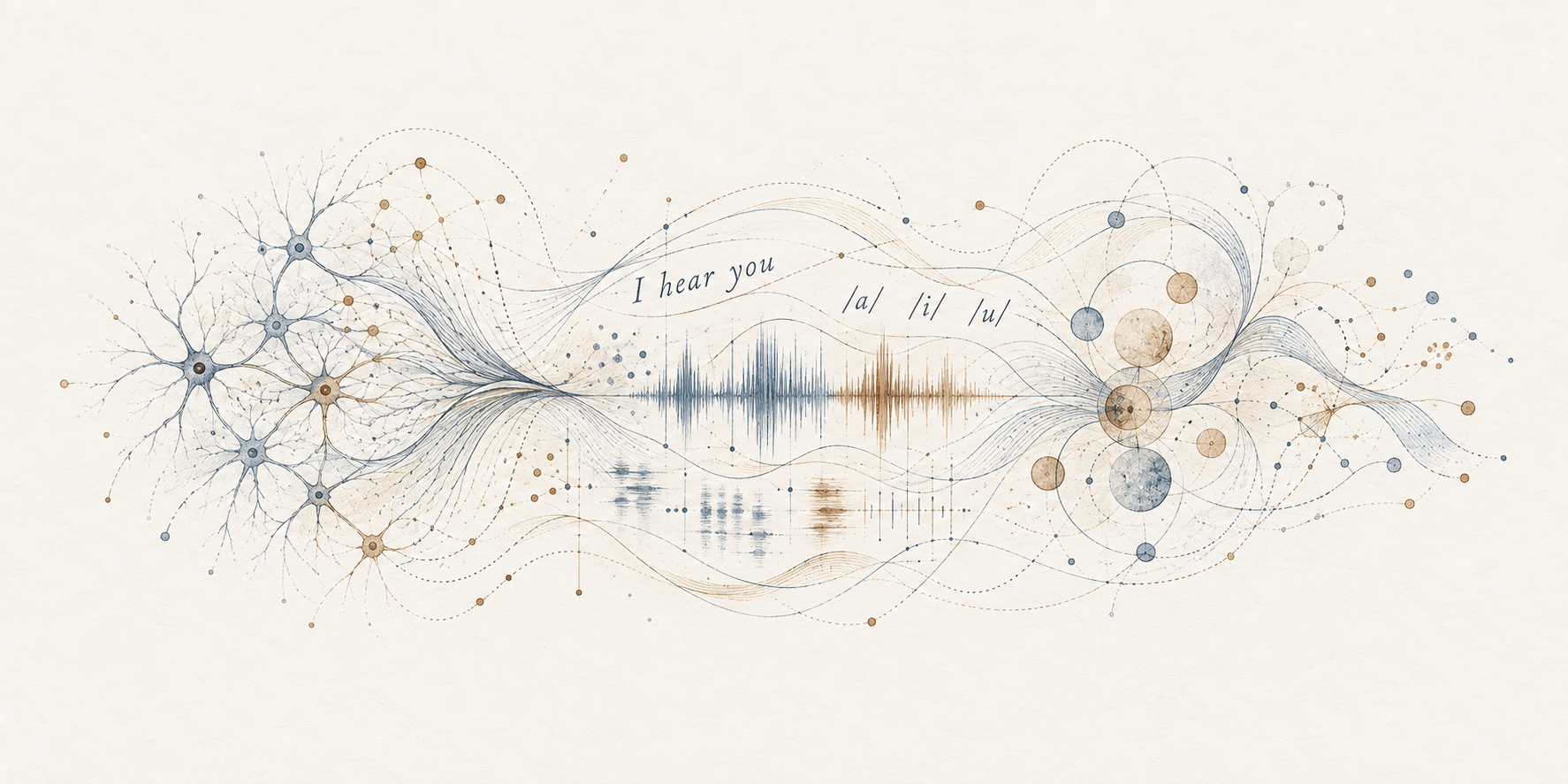



EEG foundation models learn transferable patterns from recordings of the brain’s electrical activity. But a model can learn useful representations and still make the wrong downstream prediction. Our starting question was whether the internal signals behind that prediction could help identify the error—and support a better decision.
We introduce GACE—Guidance, Assessment, and Correction for EEG Foundation Models, a framework that guides fine-tuning, estimates prediction risk, and learns when to keep or revise an answer. Across 18 task–backbone combinations, GACE improves balanced accuracy by 4.05 percentage points on average, with a maximum gain of 11.00 points, compared with standard fine-tuning of the same backbones (paper, Table 1).
The result is not a model that always recognizes its own mistakes. It is evidence that internal information beyond the final output can support error assessment and selective correction, without redesigning the pretrained backbone.
Detecting an error is not the same as knowing its replacement
EEG decoding tasks such as motor imagery, sleep staging, and imagined-speech classification ask a model to turn a neural recording into a task-specific label. The final class probabilities describe the model’s output, but they do not fully capture how that decision was formed.
That distinction matters for correction. There are two separate questions: Is the current prediction likely to be wrong? And is there enough information to choose a better alternative? A prediction can be high-risk without being straightforward to repair. Changing an uncertain answer indiscriminately can also turn a correct prediction into an error.
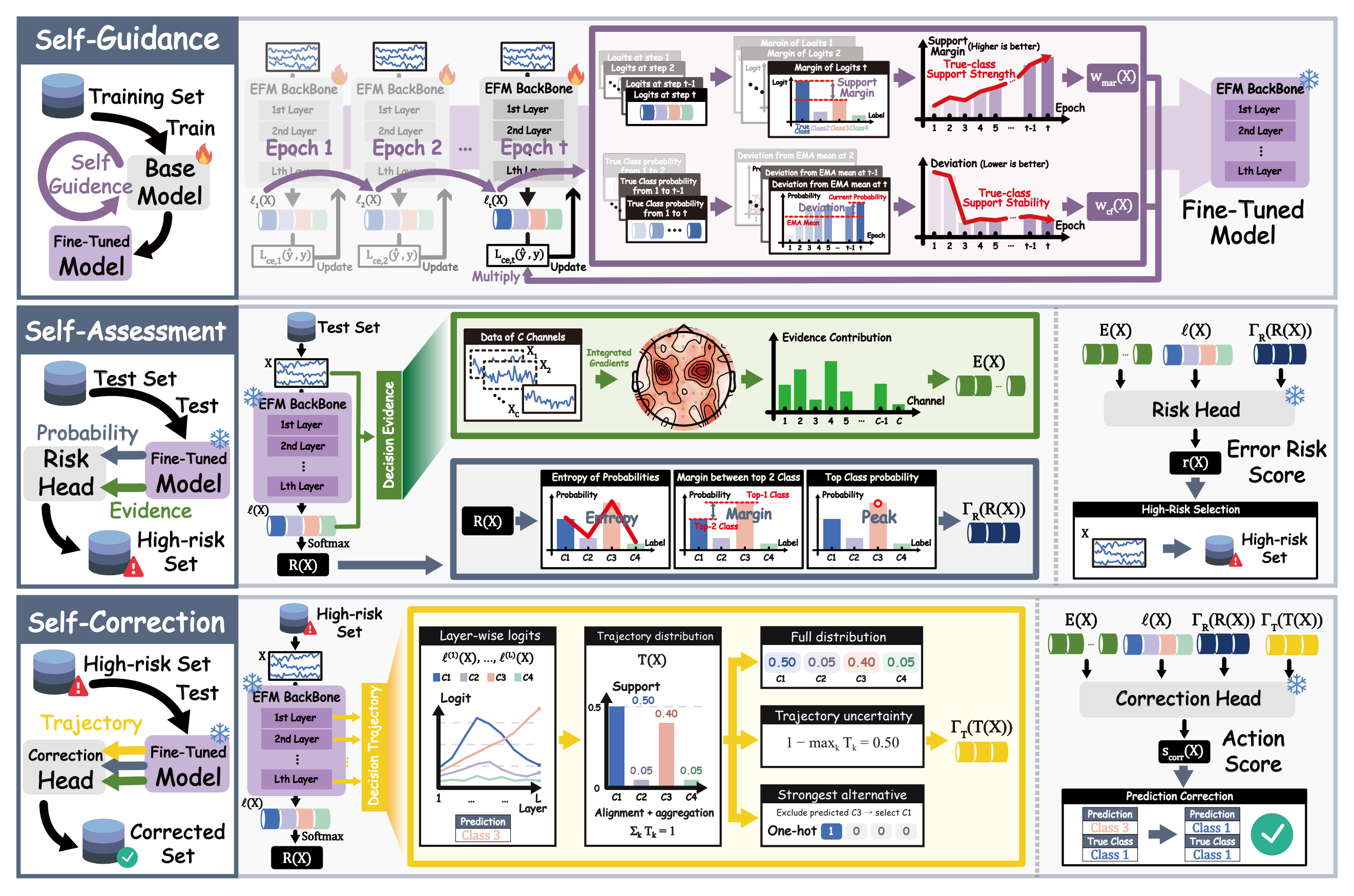
GACE separates these questions. Rather than asking the model to classify every sample again, it uses internal cues to identify predictions worth reconsidering, then learns a conditional keep-or-change policy.
Two internal signals, two different jobs
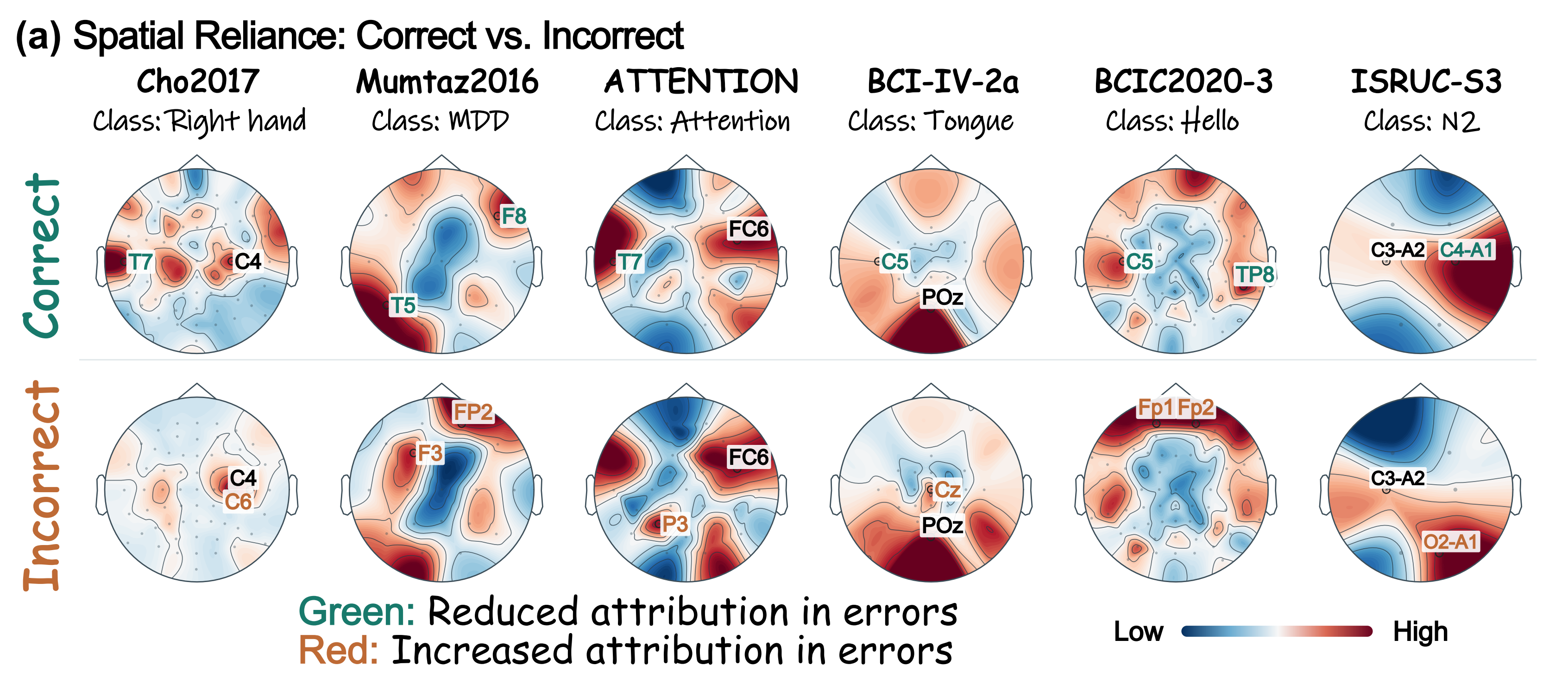
The first observation concerns where the model relies on the EEG signal. In the paper’s CSBrain analysis, correct and incorrect predictions for the same task class exhibit different channel-attribution patterns. These are associations between model reliance and prediction outcomes—not proof of a biological cause for an error.
GACE represents this spatial reliance as Decision Evidence: a normalized vector of channel-level attributions, computed using Integrated Gradients. It gives the risk estimator information about the model’s reliance across channels, alongside its final confidence.
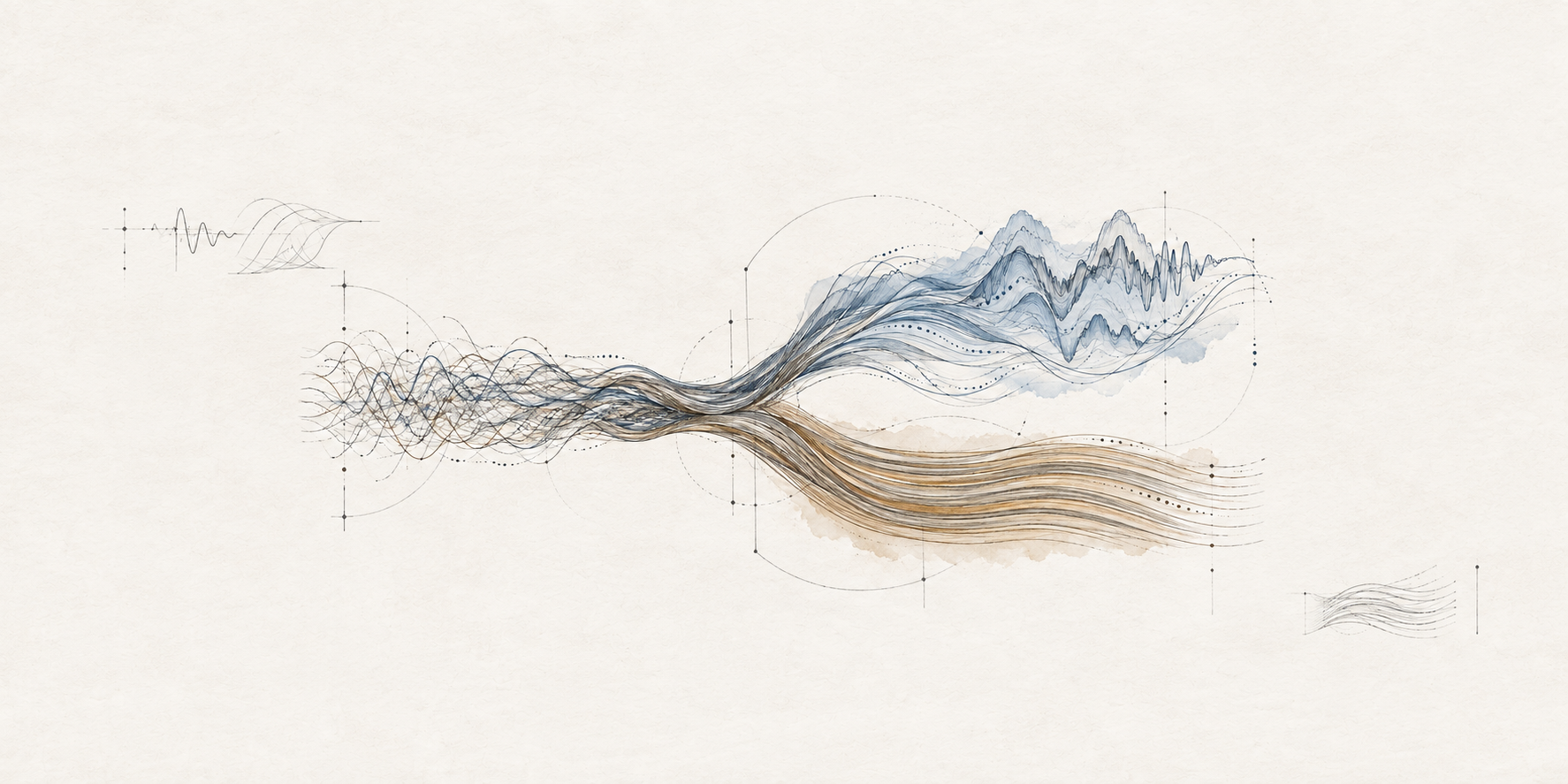
The second observation concerns how class responses differ across layers. Among predictions that are wrong at the final layer, an intermediate readout can give the true class a larger probability margin over its strongest competitor. A larger margin does not necessarily mean the intermediate prediction is correct: the margin can improve while remaining negative.
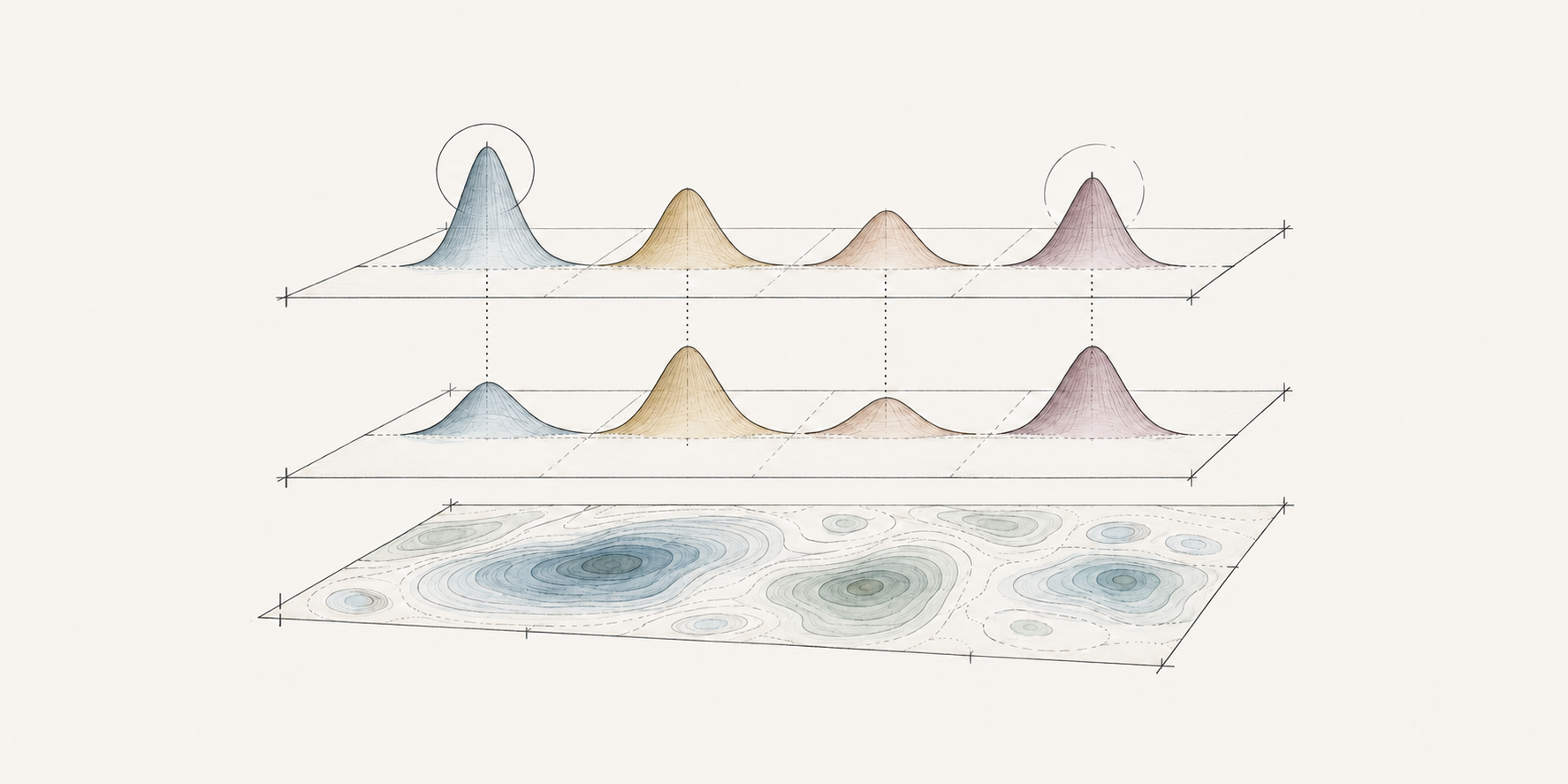
This retrospective observation motivates Decision Trajectory. GACE maps intermediate representations into a shared class space and summarizes class-wise alignment between intermediate and final logits—the model’s pre-probability class scores. The resulting feature is not an oracle for the correct label, and its largest component need not identify the true class. It is additional information from which a supervised correction head can learn.
From clearer cues to selective correction
GACE connects these signals through three stages.
Self-Guidance shapes the model from which the cues are extracted. During fine-tuning, GACE tracks support for each training example’s true class and fluctuations in the model’s confidence over time. These statistics adjust the example’s contribution to the training loss, emphasizing stronger true-class support and more stable responses. The aim is to encourage clearer internal cues, rather than impose a predefined spatial pattern. The resulting model is then frozen for the assessment and correction stages.
Self-Assessment learns which predictions deserve another look. A risk head combines Decision Evidence with final logits and probability statistics, such as confidence, entropy, and the margin between leading classes. Labeled calibration examples supply the supervision: did the frozen model get each example right or wrong? Internal cross-validation supplies out-of-fold risk scores for selecting correction-training examples. In the reported protocol, the highest-risk 12% of predictions are selected within the calibration and test splits.
Self-Correction learns when a change is justified. A second head is trained on the selected calibration examples, adding Decision Trajectory to the evidence and output features. Its target is to keep a correct prediction or choose the true class when the original prediction is wrong. At inference, only risk-selected predictions are eligible for revision. A different class must pass the correction policy’s probability gates; otherwise, the original label remains unchanged. All low-risk predictions are preserved.
Here, “self” refers to reusing the model’s own internal responses. The assessment and correction policies still require labeled calibration data. They are not trained on test examples, and they do not require test labels to make decisions.
What changed in the benchmark
We evaluated GACE on CodeBrain, CBraMod, and CSBrain across six main tasks: attention recognition, four-class motor imagery, binary emotion recognition, sleep staging, major depressive disorder classification, and imagined-speech classification. Baselines use standard fine-tuning of the same pretrained backbones, with matched preprocessing and data splits. Main results are means over three random seeds; the paper also reports their sample standard deviations (Section 4.1).
Balanced accuracy averages recall across classes, giving each class equal weight. This is the main metric used below; weighted F1 provides a complementary view of classification performance.
Gains across the main tasks, with substantial variation
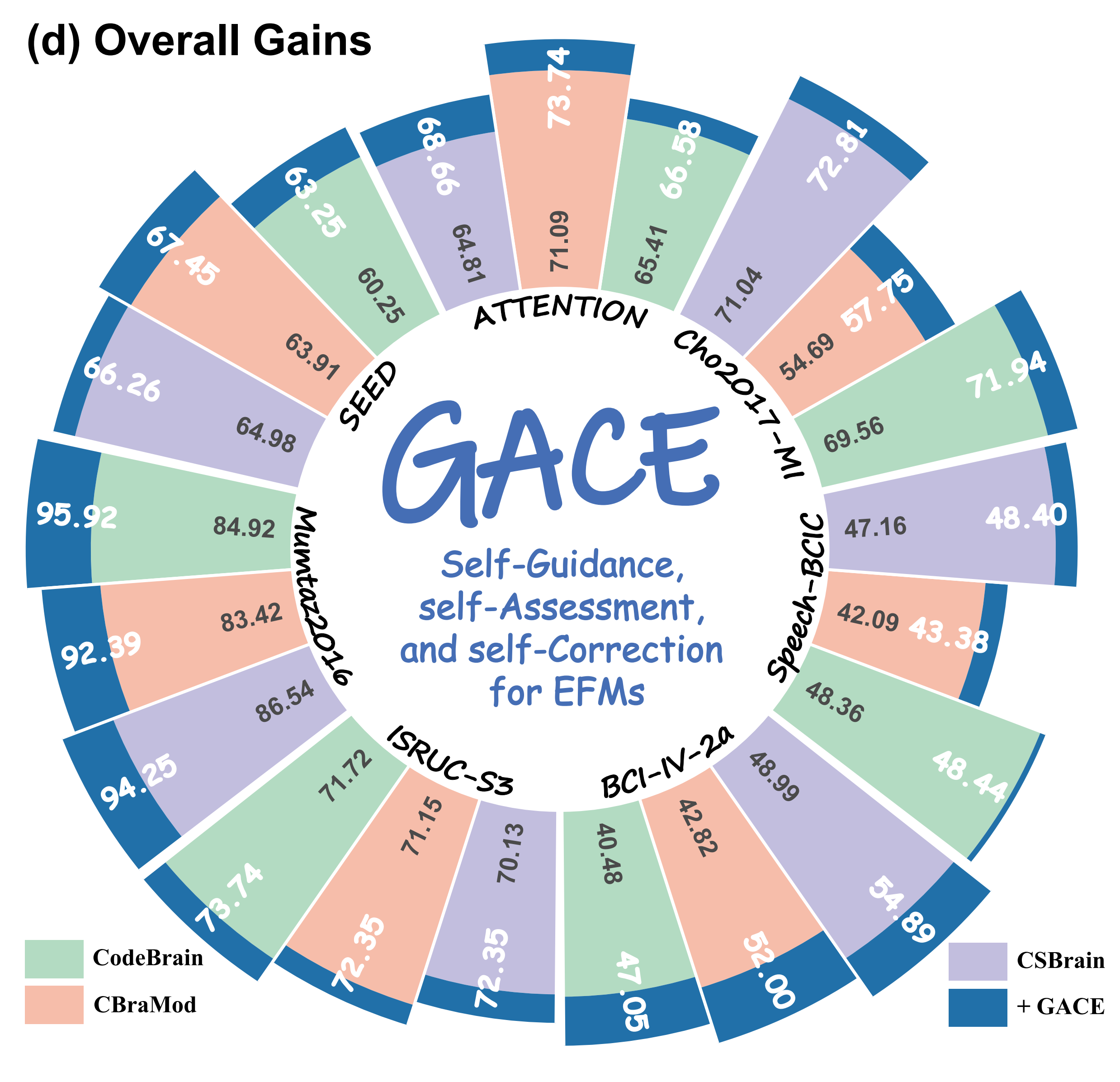
The reported mean balanced accuracy improves in all 18 main-benchmark settings. Alongside the average 4.05-point gain in balanced accuracy, weighted F1 improves by 3.86 percentage points on average (Table 1).
The largest balanced-accuracy gain is on Mumtaz2016 with CodeBrain: 84.92% to 95.92%, an increase of 11.00 percentage points. On four-class motor imagery with BCI-IV-2a, CBraMod improves from 42.82% to 52.00%, a gain of 9.18 points. These are improvements under the paper’s evaluation protocols—not evidence that the underlying tasks are solved.
The benefits are also uneven. For CodeBrain on imagined speech, balanced accuracy moves from 48.36% to 48.44%. The benchmark supports usefulness across the tested backbones and tasks, but not a uniform improvement of the same magnitude everywhere (Table 1).
Internal evidence improves error selection beyond confidence alone
To evaluate Self-Assessment, the paper measures the fraction of actual errors among the highest-risk 12% of predictions, termed RP@12%. This measures how effectively a fixed review budget concentrates on mistakes; it is not the fraction of all errors recovered.
Averaged equally across the six main tasks and three seeds, Self-Assessment reaches 62.05%–63.81% across the three backbones. The temperature-scaled maximum-probability comparator reaches 54.66%–54.88%. Self-Assessment leads the reported aggregate risk-ranking comparison for each backbone (Table 2).
This is the practical role of Decision Evidence: helping distinguish likely errors more effectively than the tested confidence-only scores. The input ablations reinforce that interpretation. Removing evidence-derived features lowers mean error-selection precision across the seven-dataset supplementary analysis (Appendix I.3, Table 15).
Learned correction adds value after fine-tuning
Correction contributes beyond Self-Guidance. Across the six main tasks, it adds 2.24–2.27 balanced-accuracy percentage points, depending on the backbone, relative to the already self-guided predictions. These aggregate gains exceed the tested correction alternatives, including switching to the second-ranked output class or using a trajectory-based alternative directly (Table 2).
Selecting the right cases also matters. In the CodeBrain ablation on BCI-IV-2a, Self-Guidance alone reaches 44.47% balanced accuracy. Replacing learned risk selection with random selection of 12% of examples reduces the result to 43.72%; the full framework reaches 47.05% (Table 3).
Together, these results support the separation between finding likely mistakes and learning how to revise them. Internal signals are useful not because they automatically reveal a correct answer, but because they provide features for a learned, conditional correction policy.
What the gains do—and do not—establish
The correction policy is conservative, but individual changes are not guaranteed to help. The paper’s diagnostics include both repaired errors and harmful changes from correct to incorrect predictions. Keeping many predictions unchanged does not, by itself, establish that the changes made were reliable (Appendix J.2).
Calibration is another boundary. The calibration-label sensitivity experiments show that correction gains can shrink substantially when fewer labeled examples are available. The paper also identifies small, noisy, or distribution-shifted calibration sets as a limitation; the benchmark does not establish general robustness to calibration noise or distribution shift (Appendices I.5 and O).
There is a deployment trade-off as well. GACE requires access to internal representations or logits and channel-level attribution, rather than only a black-box prediction interface. Its reported computational estimates for the assessment and correction heads assume precomputed features and exclude feature acquisition. Those estimates should not be read as end-to-end latency measurements (Appendix M.1).
Finally, these are downstream EEG research results, not clinical validation. In particular, the Mumtaz2016 result should not be interpreted as validating a medical diagnostic system. Clinical or other safety-critical use would require separate review and external validation, as the paper’s ethics statement makes explicit.
The next questions for reliability-aware EEG decoding
These findings point to focused next questions: how to retain useful risk ranking and correction with limited or mismatched calibration data, how feature-acquisition costs affect practical use, and how to balance repaired errors against harmful changes and missed correction opportunities. These are research directions suggested by the present boundaries, not capabilities established by this study.
GACE provides a basis for investigating them. It shows that an EEG foundation model’s internal responses can be used not only to produce a prediction, but also to learn when that prediction merits reconsideration. For longer-term neural-interface research, the contribution is a concrete, supervised way to study that distinction—without assuming that confidence is correctness, or that every uncertain answer should be changed.
Dataset
The study evaluates existing datasets rather than introducing a new GACE dataset. Original sources listed in the manuscript are linked below.
Main benchmark: ATTENTION; BCI-IV-2a; SEED; ISRUC-S3; Mumtaz2016; Speech-BCIC2020-3.
Supplementary motor-imagery benchmark shown in Figure 2(d): Cho2017-MI.